 Ethefi
 weETH: rewards without rebasing
weETH is EtherFi's non-rebasing wrapper for eETH, representing an ETH staking position. Staking rewards accrue through the amount of eETH each weETH represents, without increasing the holder's weETH token count.
What changes when staking rewards accrue?
eETH uses a rebasing balance: its token quantity adjusts as Ethereum staking rewards are accounted for. Wrapping eETH puts that position into a token whose balance does not rebase. Rewards increase the amount of eETH represented by each weETH.
The conversion rate connects these two ways of recording the position. An eETH amount converts into weETH at the applicable rate, so the quantities need not match one for one. A wallet's weETH token count alone cannot show the underlying staking accrual.
Does non-rebasing mean a fixed return?
Non-rebasing describes how the token records the position. The staking APY remains variable and rewards are not guaranteed. A displayed APY can change during the holding period; it is separate from the conversion rate reflecting the eETH each weETH represents.
The underlying position retains ETH exposure. That means staking rewards can accrue while the position's dollar value falls if ETH's market price declines. An increase in represented eETH is not a guarantee of a positive dollar return.
Is another strategy deposit needed to earn staking rewards?
The underlying ETH staking accrual is already embedded in weETH. Holding it does not require manually reinvesting those staking rewards. Using weETH in a supported lending, fixed-rate or trading market is a separate use of the position, governed by the destination's product and network conditions.
EtherFi also lists weETHs as a separate managed restaking strategy. Choosing that strategy adds exposure to additional protocols and market liquidity. Its potential rewards and additional risks should be distinguished from the staking accrual embedded in weETH.
What does unwrapping return?
Unwrapping weETH returns the eETH it represents at the applicable conversion rate. Receiving ETH involves the relevant unstaking or redemption process. Changing the token format and completing an ETH withdrawal are distinct operations.
weETH has no fixed lock period, but protocol-level waiting periods can apply to withdrawals depending on network conditions. The applicable redemption estimate and fees matter when assessing an exit; non-rebasing accounting does not establish when ETH will become available.
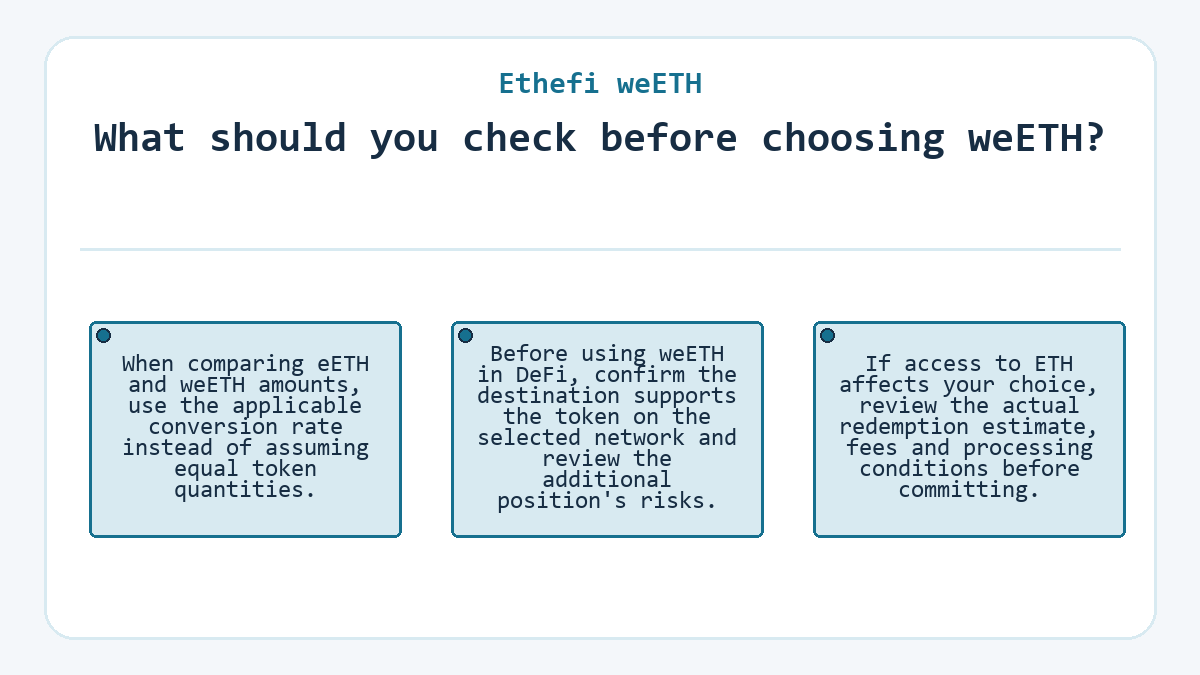
What should you check before choosing weETH?
- When comparing eETH and weETH amounts, use the applicable conversion rate instead of assuming equal token quantities.
- Before using weETH in DeFi, confirm the destination supports the token on the selected network and review the additional position's risks.
- If access to ETH affects your choice, review the actual redemption estimate, fees and processing conditions before committing.
Last updated ·